We solved every single problem there is with studying.
As students, we were tired of it.
An endless amount of material, with no direction on how to study any of it.
Lectures we didn’t understand because the professor couldn’t teach.
Anki cards that took forever to make, or giant premade decks that had nothing to do with our professor’s slides.
Nowhere to practice with questions that looked like the ones on our in-house exams.
Too many resources to juggle, with no complete system to help us master the material.
We started with these problems and brought together students from every niche: medical, nursing, pharmacy, dental, PT, PA, undergrad and many more. Then we tested this system rigorously, across thousands of lectures, until it solved every single one of these problems. For all of us.
No idea how to study
“Mine has hundreds of PowerPoints and modules and videos plus the books, that I always get overwhelmed and don’t even know where to begin and end up not really studying well or retaining anything.”
Nobody ever really teaches you how to study. You get some slides with a professor lecturing over them, and after that you’re on your own.
Most professors are researchers, and nobody trained them to teach. A lot of them are impossible to follow and learn from.
Third-party resources are good, but they’re built for everyone. None of them match exactly what your course expects you to know.
Learning falls to you. With endless options and no direction, it’s easy to spend hours on material that never shows up on your exam. However, with the right system, you’ll understand new material much better and in far less time. The system is three simple steps you do for every one of your lectures:
First, understand the information and the reasoning behind it. The best teachers take a hard concept and break it down so simply that you can visualize it perfectly. Building that framework in your head is absolutely vital. Without this step, all the time you spend memorizing is for nothing, because you are almost guaranteed to forget it.(Bransford & Johnson, 1972)
Second, memorize the important details. Most students skip step one and try to memorize everything up front. This does not work. Your brain has no framework to hang random, segmented pieces of information off of. Pin the most important points to the framework you already understand, and you will be able to recall 96% of them, versus 18% if you just memorize them up front.(Craik & Tulving, 1975)
Third, apply it to real exam questions. Understanding and memorizing something is one thing. Answering a question written about it, under exam conditions, is another. You need to take the concepts you now understand and apply them to real exam questions, written the exact way your exam will ask them, from the exact lecture they were made from.(Butler, 2010)
Apply this system to every single one of your lectures, and the exam has nothing left to surprise you with. Every question is one you’ve already understood, memorized, and answered once before.
Understand the why
“Because it takes me so long to understand something, even if I study for hours, it feels like I essentially did nothing.”
You’ve reread the slide, replayed the lecture, and looked up another explanation. You’ve put in the time, but you still can’t seem to fully grasp what’s going on.
You’re not stupid. There’s a gap in the chain.
When an explanation skips the basics, introduces unfamiliar terms without explaining them, or never connects the idea to something you already know, every new detail builds on a foundation that isn’t solid yet. You lose time rereading the same explanation or searching for another one that fills in the missing steps.
A good explanation starts with something familiar and builds from the basics, showing you how each step leads to the next without any gaps(Merrill, 2002). Here’s an example from a pharmacology lecture.
Chapter oneWhy Coffee Wakes You Up
What’s the longest you’ve ever gone without sleep? Somewhere past hour twenty your eyes start to sting, and by morning your head feels heavy in a way that one good sleep fixes completely. Where does that heaviness come from?
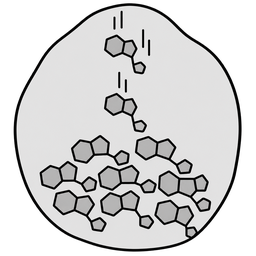
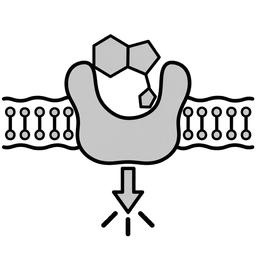
From a chemical. Every cell in your brain burns energy all day, and one of the leftovers is a small molecule called adenosine. It doesn’t get cleared while you’re awake. It builds. On the outside of your brain cells sit tiny locks called receptors, shaped to fit adenosine exactly. When adenosine slots in, the cell gets one message: slow down. That is what tired is.
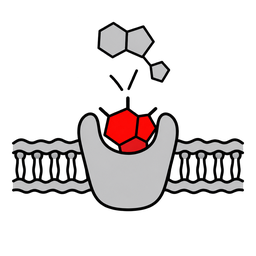
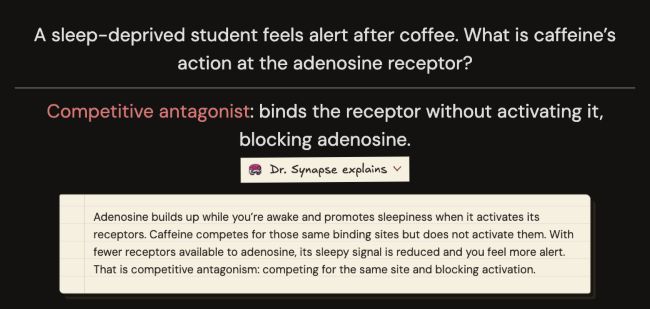
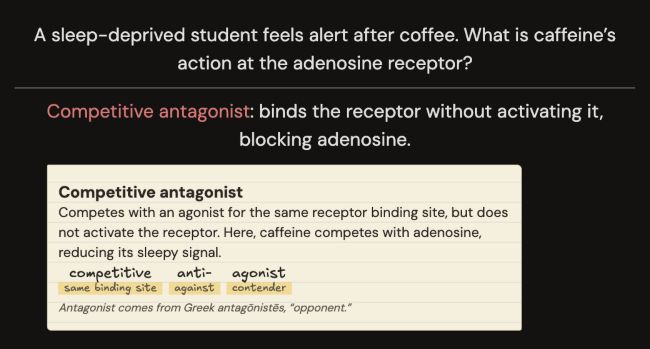
Now the coffee. Caffeine is almost the same shape as adenosine. Close enough to fit the lock. Not close enough to turn it. So it slides in, sits there, and blocks the door. Adenosine can’t get in, the message never gets sent, and you feel awake. That’s the whole trick, and it has a name you’ll see for the rest of pharmacology: caffeine is an antagonist. A key that fits, but won’t turn.
Hours awake
Adenosine builds up
Adenosine turns its lock: “slow down”
Coffee
Caffeine sits in the lock instead
No “slow down”: awake
This is how you build that foundation. Each new detail connects to something you already understand. Your lecture’s main pathways are built into the Story, with each step drawn out beside the explanation. Every yellow term opens its meaning, word parts, and origin, reinforcing the concept as you read. With the definitions, pathways, and explanations all in one place, you will understand your lecture in less time without stopping to Google for the missing pieces.
Active recall
“I am in second year now and i just keep rereading textbooks and cant retain anything.”
Step two is memorizing. Now that you’ve built the framework, you can start committing the important details to memory.
Most students do this by rereading their notes until the material feels familiar. It feels like you’re being productive, but the answers are always right in front of you. You’re not practicing remembering them on your own, the way an exam makes you. That’s why you can spend hours studying and still draw a blank on exam day. You never practiced active recall.
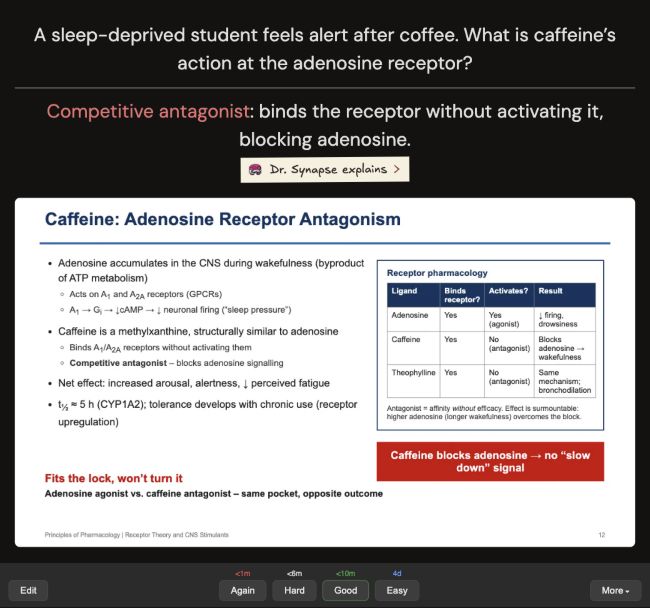
Active recall is getting asked a question and pulling the answer out of your head with nothing in front of you, exactly what the exam makes you do. Anki does this, and it’s completely free.
“It takes SO long to just create the flashcards, on top of actually studying them.”
Turning one lecture into a useful deck can take hours. You have to decide what matters, write the questions, and format each card. Adjusting fonts, colors, and layouts, copying information, or even making cards from the notes in front of you is not practicing recall. Doing the deck means trying to answer each card from memory. Make that a consistent habit. Testing yourself helps you remember the answers later(Roediger & Karpicke, 2006).
“The Anking deck…wouldn’t be the best for studying in house material.”
Starting with a premade deck can save you that work, but it will not cover exactly what your in-house lectures teach. We build your deck directly from your source material, so you can spend that time actually practicing active recall. Each deck includes:
The right number of cards for the material, not one per bullet point.
The right question for each fact, worded so you can’t answer it by recognition.
The slide it came from on the card, so you know exactly where the information is.
A dropdown with a further explanation.
Key terms highlighted, with Amboss-style tooltips: exactly what the term means and where the word comes from.
Deciding what deserves a card can be the difference between knowing and not knowing something on exam day. We tackled that problem specifically. The deck is built from many different signals: the session objectives, the summary slides, and the way your professor words things. It checks all of it against thousands of exams to decide what actually gets tested and what is actually testable. That level of detail takes away the anxiety of not knowing what is important and what needs to be studied.
Apply it to real questions
“A lot of the questions on the exams are about critical thinking and it doesn’t explicitly restate the content.”
Step three is applying it. You can know every single fact and still get the question wrong. An exam might describe a situation you’ve never seen before and ask you to work out what’s happening. You have to recognize the concept being tested, connect the details, and explain why one answer fits better than the others.
Practicing with new questions helps you apply what you’ve learned(Butler, 2010). But most courses don’t hand out the exams you’ll see.
So we trained our model on thousands of exams to write practice questions from your source material. It takes the concepts in your lecture and builds questions around them, tailored to your field and level of study. You practice working through scenarios, picking out the details that matter, and choosing between plausible answers, all on the material you’re actually responsible for.
Practice ExamsCaffeine and Receptors3/103 correct
HIGH YIELD
A 20-year-old student has been awake for 19 hours and drinks two espressos at 9 pm. At 1 am she is still alert even though the adenosine level in her brain is high. Which of the following best explains caffeine’s effect at the adenosine receptor?
Every question walks you through why the right answer works and why your chosen answer does or doesn’t fit, with the original slide alongside the explanation. Reviewing the feedback helps you correct mistakes before you repeat them(Butler & Roediger, 2008). And right or wrong, there’s a meme waiting for you to make practice a little more fun.
Nothing does all three
“At this point I can't tell if I'm improving or just collecting resources.”
Every other resource does one of the three steps. Never all of them.
There are very good third-party explanations out there. They help you understand, but they won’t help you memorize or apply. There are good Anki decks. They help you memorize, but they won’t help you practice, and they weren’t made from your lecture. Question banks give you practice, but they can’t explain what you never understood in the first place.
Nothing has ever been built that does all three steps for you, from the same lecture, in order. So that is what we built.
If you never want to worry about failing an exam again.
If you want to walk into every exam already confident.
If you want zero ambiguity about how to study.
If you want one simple study system for every lecture, without the complicated setup or jumping from one resource to the next.
Start with one of your lectures. We’ll turn it into what you need to understand it, remember it, and practice using it.
Upload your lecture
StoryUnderstand
Anki deckRemember
Practice examApply
The only three things you need to ace your exam.
3 free credits
Create your free account and try all three outputs on one of your lectures. No credit card needed. Start with one lecture and see the difference.